


You open Google Search Console and see 3,000 unexpected URLs indexed.
Spam pages.
Old migration debris.
Parameter duplicates.
Thin content that should never have existed.
Or worse, traffic is stable, but you know your index is bloated and crawl activity is being wasted on URLs that no longer matter.
When you need to remove hundreds or even thousands of URLs, a bulk 410 redirect is one of the cleanest ways to signal permanent deletion to search engines.
But before we go deep into crawl budget, authority containment, and structural risk, let me show you my preferred implementation method in WordPress. This answers the practical query immediately.
My Favorite Way to Do a Bulk 410 Redirect in WordPress
If you are using WordPress, install Rank Math SEO and make sure the Redirections module is toggled on.

Then:
- Go to Rank Math > Redirections
- Click Add New
- Grab all the URLs you want to 410
- Paste them inside the Source URLs box
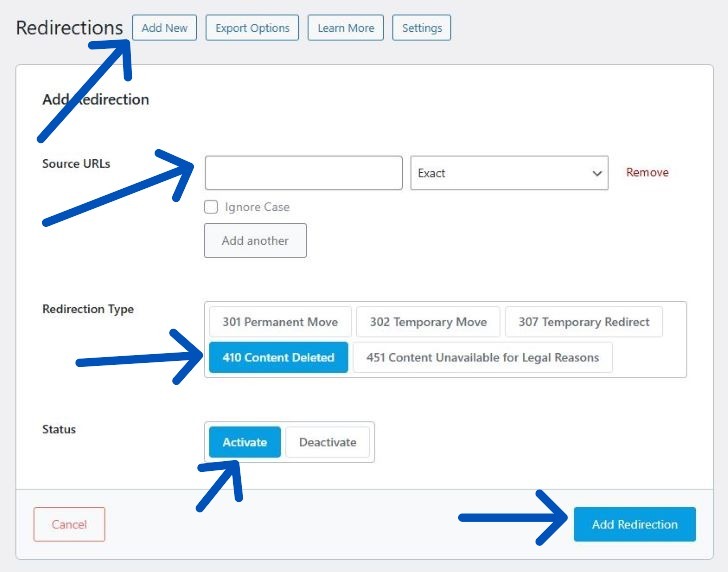
This part confuses many people.
The Source URLs box looks like it is intended for a single URL submission. Do not worry. You can paste multiple URLs there, each on a new line.
After adding the URLs:
- Choose Redirection Type
- Select 410 Content Deleted
- Set the status to Activate
- Click Add Redirection
That is it.
You have just deployed a bulk 410 redirect without editing server files, touching .htaccess, or manually repeating entries one by one.
Why I Prefer This Method
When managing large scale removals, the real risk is not the 410 itself.
It is:
- Human error
- Missed URLs
- Formatting mistakes
- Inconsistent rule deployment
- Lack of centralized oversight
Rank Math’s Redirections module allows you to:
- Paste multiple URLs at once
- Manage rules in a centralized dashboard
- Export and reimport redirection rules
- Maintain visibility over structural cleanup
From a systems perspective, this significantly reduces operational risk compared to manual server edits.
Streamline Your Bulk 410 Redirect Workflow
If you are regularly cleaning up expired, hacked, or thin URLs, structured redirect management inside WordPress is far safer than editing server configuration files manually.
Rank Math’s Redirections module makes bulk 410 deployment simple, centralized, and efficient. Instead of maintaining scattered server rules, you keep everything inside your WordPress dashboard with full visibility and control.
Download Rank Math SEO (Free) or upgrade to PRO for CSV bulk import here
I recommend it because it reduces implementation risk and increases structural clarity, especially when dealing with large scale URL cleanup.
Choose Free if you only need manual multi-URL management.
Choose PRO if you need scalable CSV-based deployment.

What a 410 Status Code Actually Signals
A 410 status code tells search engines:
- The page is permanently removed
- The removal is intentional
- The content is not returning
Unlike a 404, which simply says “not found,” a 410 sends a stronger removal signal. In many cases, deindexing happens faster.
If you are unsure how search engines differentiate these signals, reviewing the difference between 410 vs 404 helps clarify removal intent.
However, speed is not the only variable that matters.
When you deploy bulk 410 redirects at scale, you are modifying the structural footprint of your website. That affects crawl allocation, internal linking pathways, and authority signals.
As an SEO consultant, I rarely recommend mass removals without first understanding the structural dependencies behind those URLs.
This is why large scale removal should follow a proper technical SEO audit.
When Bulk 410 Redirect Is the Right Move
Bulk 410 deployment makes sense in specific scenarios.
Hacked URL Cleanup
If your site was injected with spam pages, you typically do not want to redirect them. You want them permanently gone.
In these cases, bulk 410 is efficient and clean.
I cover this scenario in detail in my guide to bulk 410 for hacked URLs, where containment matters more than consolidation.
Large Scale Thin Content Pruning
Large sites often accumulate thousands of low value URLs over time. Removing them improves index clarity, but only if you confirm they are not carrying backlinks or internal authority.
Otherwise, you risk deleting signals blindly.
Migration Debris and Legacy URLs
After redesigns or platform migrations, legacy URLs frequently remain indexed.
When structural cleanup is not modeled correctly, SEO can become unstable after migrations and redesigns. Bulk 410 can stabilize that layer when used deliberately.
The Risks of Deploying Mass 410 Without Diagnosis
The mechanical step is easy.
The strategic layer is not.
Bulk 410 affects:
- Crawl patterns
- Internal link equity
- Index composition
- Topical footprint
If internal links still point to URLs you just removed, you create structural inefficiencies.
If backlinks exist, you may be discarding authority instead of consolidating it. In those cases, understanding when to use 410 instead of 301 becomes critical.
I regularly perform traffic drop analysis where the root cause traces back to structural changes deployed months earlier.
Search systems interpret patterns, not isolated actions.
Large scale removal without evaluation can resemble:
- Site contraction
- Authority decay
- Topical shrinkage
That does not mean you should avoid bulk 410.
It means you must deploy it with intent.
Crawl Budget and Deindexing Behavior After Mass 410
One of the biggest misconceptions is that removing URLs instantly frees crawl budget.
In reality, search engines must:
- Revisit removed URLs
- Confirm persistent 410 responses
- Recalculate crawl allocation
Short term crawl volatility is normal.
Long term clarity is the objective.
If you want a deeper breakdown of how search systems recalibrate after removal, review my analysis of crawl budget behavior after mass 410 deployment.
Understanding this prevents premature panic during temporary fluctuations.
Bulk 410 Redirect Is Technical Hygiene
Over time, most sites accumulate:
- Expired landing pages
- Parameter duplicates
- Test environments
- Thin content
- Spam injections
If unmanaged, that creates index bloat and authority diffusion.
Bulk 410 redirect management helps restore clarity.
However, if you repeatedly find yourself needing large scale removal, it often indicates deeper architectural governance issues.
Removal is corrective.
Structure is preventative.
Frequently Asked Questions About 410 Redirects
Can I Paste Multiple URLs Into Rank Math Redirections?
Yes. Even though the Source URLs box appears designed for single URL entry, you can paste multiple URLs on separate lines and assign them a 410 Content Deleted status.
Does 410 Remove Pages Faster Than 404?
In many cases, yes. A 410 signals permanent removal, which can accelerate deindexing compared to a 404. Speed still depends on crawl frequency and site authority.
Will Bulk 410 Hurt My SEO?
It can if deployed without evaluating backlinks, internal links, and structural dependencies. Always validate removal decisions before activation.
Is Bulk 410 Better Than Redirecting to the Homepage?
Redirecting unrelated URLs to the homepage often creates weak or confusing signals. If the content is permanently gone and not being replaced, 410 is often cleaner.