

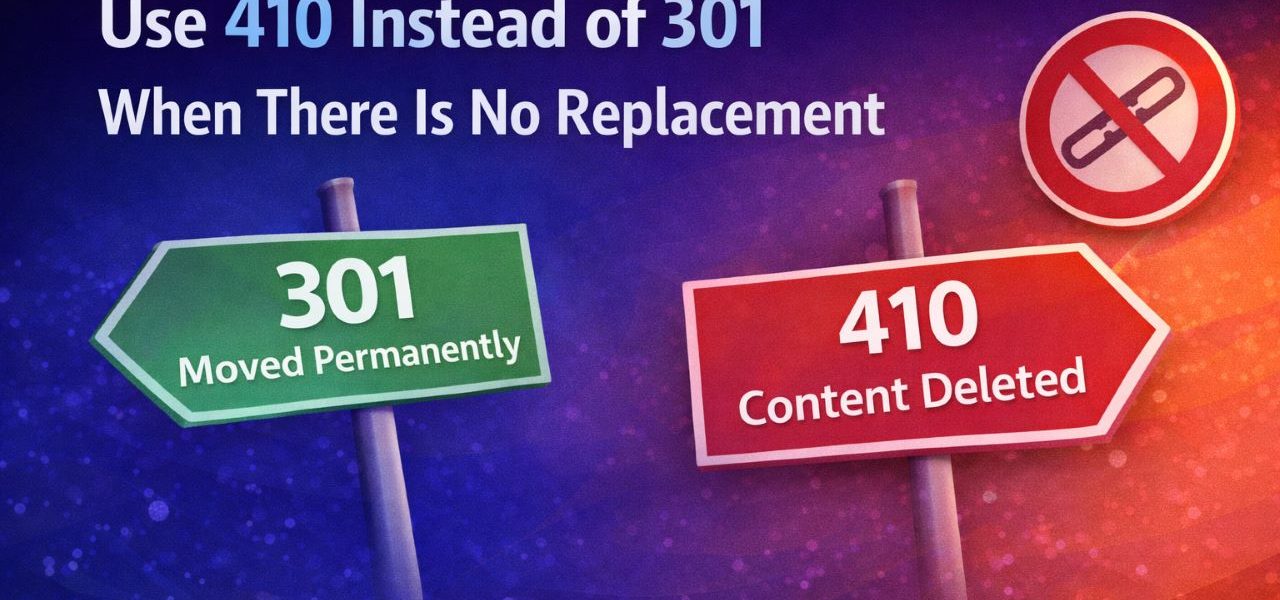
One of the most common cleanup mistakes I see is defaulting to 301 redirects when a 410 would have been more appropriate.
Both are permanent responses.
But they communicate very different intent signals.
A 301 says:
“This content moved. Transfer its signals.”
A 410 says:
“This content is gone. Do not transfer anything.”
Choosing incorrectly is not a minor technical detail. It is an architectural decision.
If you are implementing a structured bulk 410 redirect strategy, understanding this distinction becomes critical.
The Structural Difference Between 410 and 301
Here is the core distinction:
- 301 Redirect consolidates authority and signals that a URL has permanently moved.
- 410 Gone eliminates the URL and prevents signal transfer.
The correct choice depends entirely on your objective.
If your goal is authority preservation, 301 is appropriate.
If your goal is clean removal without consolidation, 410 is cleaner.
When 410 Is the Correct Choice
Use 410 when:
- The content is permanently removed
- There is no relevant replacement
- The URL has no valuable backlinks
- The page was hacked or spam
- The content no longer supports topical structure
For hacked scenarios, redirecting spam URLs to your homepage creates weak and irrelevant signals. In those cases, structured removal such as described in my guide to bulk 410 for hacked URLs is often cleaner.
If permanence is confirmed, 410 accelerates clarity.
When 301 Is the Correct Choice
Use 301 when:
- A clear replacement page exists
- Backlinks should be preserved
- Content was consolidated
- A URL moved location but remains relevant
If a URL carries authority and relevance, discarding it with 410 results in signal loss.
This is where understanding the broader difference between 410 vs 404 also helps, since 404 introduces ambiguity while 410 confirms finality.
Status code selection is not mechanical.
It is contextual.
The Hidden Risk of Redirecting Everything
Many site owners redirect all removed pages to the homepage.
This often leads to:
- Relevance dilution
- Soft 404 interpretation
- Confusing signal consolidation
- Crawl inefficiencies
If the removed content has no logical destination, 410 is more honest and structurally cleaner.
After large scale 410 deployment, crawl behavior recalibrates gradually. If you want to understand how that stabilization works, review my analysis of crawl budget behavior after mass 410.
Authority Containment vs Authority Transfer
Think in terms of signal flow.
301 = transfer.
410 = containment.
If authority should move, use 301.
If authority should be eliminated, use 410.
Making that decision requires evaluating:
- Backlink profile
- Internal link references
- Revenue impact
- Topical footprint
Before deploying removal at scale, validate impact through a proper technical SEO audit.
As an SEO consultant, I treat redirection decisions as architectural governance, not quick fixes.
Large Scale Cleanup Requires a Decision Framework
When removing hundreds or thousands of URLs, use a simple evaluation process:
- Does the URL have backlinks?
- Does it receive meaningful traffic?
- Is there a relevant replacement page?
- Is the content permanently gone?
- Does removing it shrink topical authority?
If the answer to preservation is yes, use 301.
If the answer to permanence without replacement is yes, use 410.
Large scale misjudgment often contributes to cases where SEO traffic drops are caused months before you notice.
Strategic Clarity Prevents Structural Instability
The decision between 410 and 301 is rarely about speed.
It is about intent.
410 improves clarity when removal is correct.
301 preserves value when relocation is appropriate.
When implemented deliberately, both stabilize structure.
When deployed reactively, both create volatility.
The difference lies in diagnosis before execution.
Frequently Asked Questions
Is 410 Better Than 301 for SEO?
Not inherently. 410 is appropriate for permanent removal without signal transfer. 301 is appropriate when consolidating authority to a relevant replacement.
Will I Lose Backlinks If I Use 410?
Yes. If the removed URL has backlinks, a 410 discards that authority instead of transferring it.
Can I Use 410 for Discontinued Products?
Yes, if there is no relevant replacement. If a close alternative exists, 301 may be strategically superior.
Should I Redirect Everything to the Homepage?
No. Redirecting unrelated URLs to the homepage often creates weak signals and may be interpreted as soft 404 behavior.